
Governor Wes Moore
100 State Circle
Annapolis, Maryland
21401-1925
Dear Governor Moore,
The Maryland Alliance for Racial Equity in Education (MAREE) and the undersigned group of Maryland education, civil rights, and community-based organizations writes to express our deep concern with the new Federal Voucher Tax Credit (FVTC) program authorized under the One Big Beautiful Bill Act and to urge Maryland to OPT-OUT of participating.
This program will place private interests ahead of Maryland’s public school students – funneling significant public funds towards private educational institutions that refuse to serve all students while leaving those students with the highest needs with fewer resources. The U.S. Treasury Department recently released regulations for the program which confirm that if Maryland chooses to participate we will assume significant administrative responsibilities and legal risks while being denied the power to shape the program in ways that reflect our state’s priorities, safeguard our public resources, and ensure positive outcomes for our students.
We urge you to opt-out of participating in the Federal Voucher Tax Credit because:
Treasury’s regulations make clear that state leaders will not be able to shape the list of Scholarship Granting Organizations (SGOs) that can provide FVTC-funded vouchers, nor will they be able to impose substantive requirements on SGOs beyond those established in federal law. This means that governors cannot shape the program to prioritize public school students, nor can they place restrictions on the program to ensure funds are spent equitably. Furthermore, Maryland cannot require that funds are distributed in a manner aligned with our education priorities, targeted toward students with the highest needs, or spent on evidence-based resources. In short, we cannot make this program into the one we might wish it to be – we must accept it for what it is, a private school voucher program, and reject it accordingly.
Under the FVTC individual taxpayers and SGOs hold the power to determine who receives financial support. This means any amount of support for public school students or those with additional needs will be based on which services SGOs decide to fund, and which SGOs individuals choose to donate to. Our organizations believe in expanding opportunities for those with the highest needs and are deeply concerned about the lack of access to resources like high-dosage tutoring, afterschool programs, and technology that students of color, students from low-income backgrounds, multilingual learners, and students with disabilities face. However, this program will only further entrench inequity by subsidizing resources for those who can already afford them, rather than expanding opportunity for those most in need. Under the FVTC, students from families earning up to 300% of their area’s median income may qualify — making roughly 90% of U.S. families eligible, including many high-income and affluent households. In some counties in Maryland, that means families making up to $471,900 annually can participate. Rather than targeting students with the greatest needs, the program makes public subsidies available to many families who already have access to private educational options
Furthermore, private school voucher programs are overwhelmingly used by families whose students are already enrolled in private schools. In New Hampshire, 89% of students enrolled in the state’s voucher program never attended public school. In Arizona, families in the highest income zip codes use the state’s voucher program at disproportionately high rates, leaving the Brookings Institution to conclude that “nothing … even remotely suggests that this program is addressing inequities in school access by students’ socioeconomic status.” Voucher programs have also been shown to promote segregation, and are disproportionately used by white families.
Those schools serving students with the highest needs are the very ones with the least capacity to set up entirely separate organizations to serve as SGOs, nor do they have the capital to make the upfront investment necessary to create such an organization and attract a large donor base. Furthermore, these schools do not serve communities with large numbers of
individuals who have $1,700 available to “donate” to an SGO and wait for the subsequent credit on their taxes. The highest-need schools, and the students they serve, will be at a fundamental disadvantage under the FVTC – forced to rely on the kindness of strangers for the services they should be receiving from their government.
Maryland has long-made a commitment to ensuring ALL students receive the support they need to excel in the classroom by making tailored investments that prioritize equity. The FVTC denies our state the power to ensure these public funds are targeted – leaving equity to be enforced by the whim of the people rather than the power of law.
Maryland has spent decades building systems to increase transparency, improve student outcomes, and ensure that public investments are accompanied by public accountability. Public schools are required to publicly report student achievement data, administer state assessments, comply with civil rights protections, adhere to open meeting and public records laws, undergo financial oversight, provide extensive financial disclosures, and serve all students who enroll. These requirements exist because public resources should be tied to measurable outcomes, transparency, and accountability to families and communities. Yet comparable requirements have not been established for schools and organizations benefiting from the FVTC program. The federal voucher program does not guarantee that the private providers who benefit from the program will be subject to the same civil rights protections, transparency requirements, or obligations to serve all students that govern public schools. This fact should concern anyone who believes public investments should be accompanied by public oversight and public responsibility.
The Treasury Department’s recent regulations make clear that federal oversight is focused primarily on SGOs’ eligibility, certification, reporting, and recordkeeping requirements rather than on academic accountability measures. There is no system for tracking student achievement or program quality, nor have they extended any federal civil rights requirements to programs students attend using funding from participating SGOs.Treasury has gone a step further by explicitly stopping states from enacting regulations which ensure SGOs fund programs that uphold students’ civil rights, offer high-quality and evidence-based experiences, or increase academic achievement. Participation in such a program leaves Maryland students open to an unregulated and potentially dangerous marketplace with no assurance that doing so will have a positive impact on students’ learning.
The FVTC program is not a source of new funding for state education systems. Instead, Treasury’s regulations clarify that this is an unfunded mandate that could destabilize funding for Maryland’s public schools. States will be expected to review annual financial and programmatic audits submitted by SGOs and monitor compliance with federal requirements. These responsibilities cost money. States will need staff capacity, legal resources, and systems to review audits and investigate concerns. Furthermore, states will face potential lawsuits from SGOs that object to the results of their oversight findings.
Although Maryland’s public schools are not perfect, they are designed to serve all students, regardless of income, disability status, language background, or academic achievement. The FVTC program would create incentives to shift public resources toward a parallel system of private education that is not required to meet the same standards for access, accountability, transparency, or student outcomes. Experience from states with large-scale voucher programs suggests that these policies can increase fiscal pressures on states and districts and may exacerbate enrollment declines and school closures. As students leave public schools, districts often lose funding tied to enrollment, even though many fixed costs — such as transportation, facilities, and staffing — remain. This dynamic can force difficult budget decisions, school closures, and reductions in student services. The experience of states such as Arizona demonstrates how voucher expansions can generate costs that far exceed initial projections while diverting attention and resources away from strengthening the public schools that educate most students. Treasury’s own estimates expect the FVTC to cost $26 billion per year. This is more than IDEA and Title 1 – the two largest federal education funding streams states like Maryland rely on to serve students with the highest needs.
Maryland is already facing a structural deficit, and every dollar and staff hour spent administering a private voucher system is one not spent fulfilling our commitments to public schools. At a moment when the State must make difficult budget choices, Maryland cannot afford to take on an open-ended commitment with no clear return on investment for our students.
The Sensible Choice Is to Opt-Out of the Federal Voucher Tax Credit
The recent release of program regulations confirms that participation in the FVTC program will require states to assume substantial oversight responsibilities, administrative costs, and legal risks while offering no authority to shape the program or ensure alignment with state education priorities.
Through the Blueprint for Maryland’s Future, our state made a generational commitment to students, families, and educators: to expand early childhood education, elevate and diversify the teaching profession, prepare every student for college and career, and direct additional resources to the students and communities that have been underserved for far too long. Those commitments are built on accountability and the belief that every student deserves an excellent public education. The Federal Voucher Tax Credit runs counter to that vision. It shifts attention and resources toward private options that are not bound by the Blueprint’s standards, its accountability measures, or its commitment to serve every child.
We urge you to OPT-OUT of the Federal Voucher Tax Credit and continue focusing state resources on policies that are evidence-based, improve student outcomes, and benefit all students.
Thank you for your time and consideration. Our organizations stand ready to work with you to further discuss our concerns and highlight alternative actions Maryland can take to truly benefit those students and families in need of support.
Sincerely,
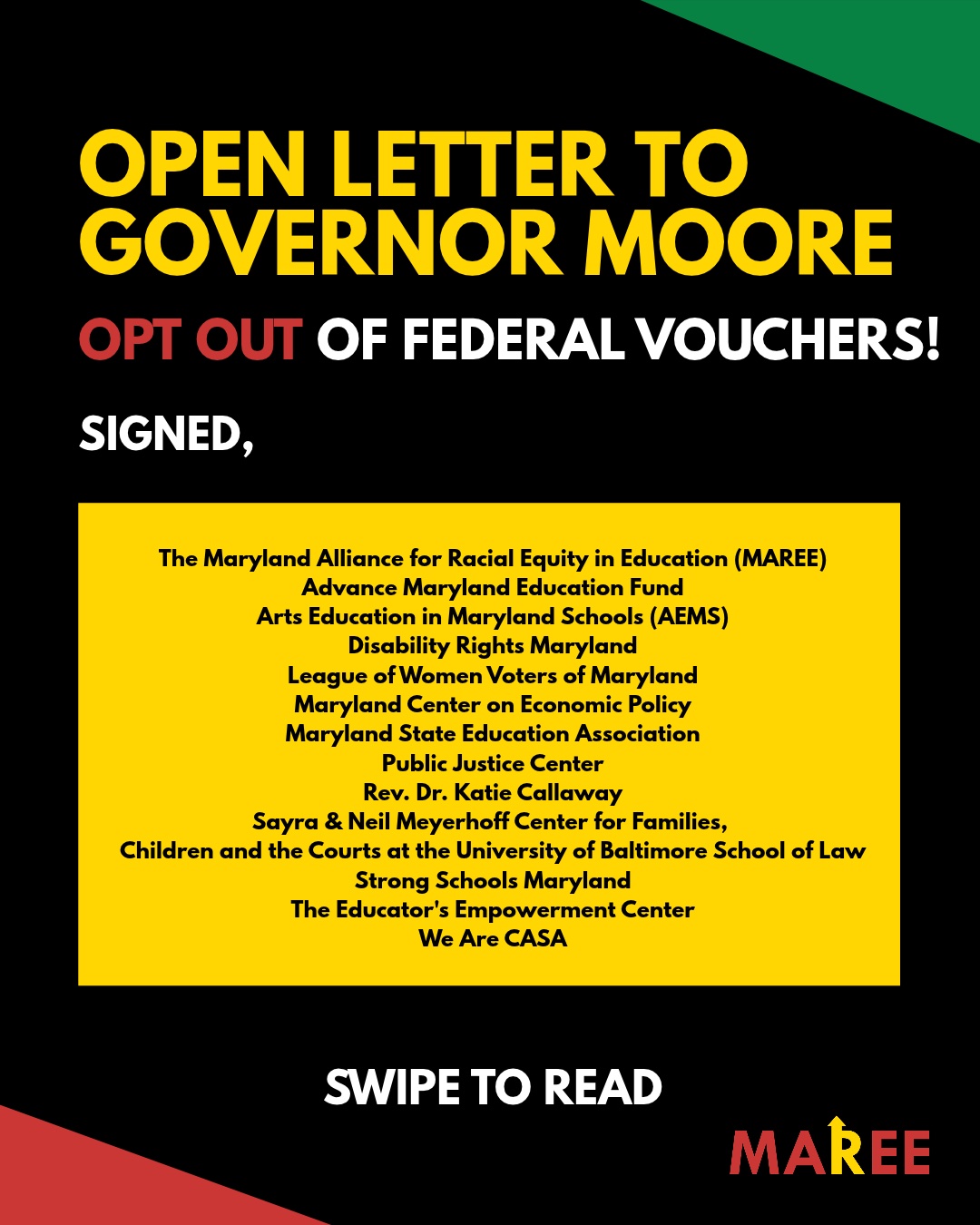
The Maryland Alliance for Racial Equity in Education (MAREE)
Advance Maryland Education Fund
Arts Education in Maryland Schools (AEMS)
Disability Rights Maryland
League of Women Voters of Maryland
Maryland Center on Economic Policy
Maryland State Education Association
Public Justice Center
Rev. Dr. Katie Callaway
Sayra & Neil Meyerhoff Center for Families, Children and the Courts at the University of Baltimore School of Law
Strong Schools Maryland
The Educator’s Empowerment Center
We Are CASA
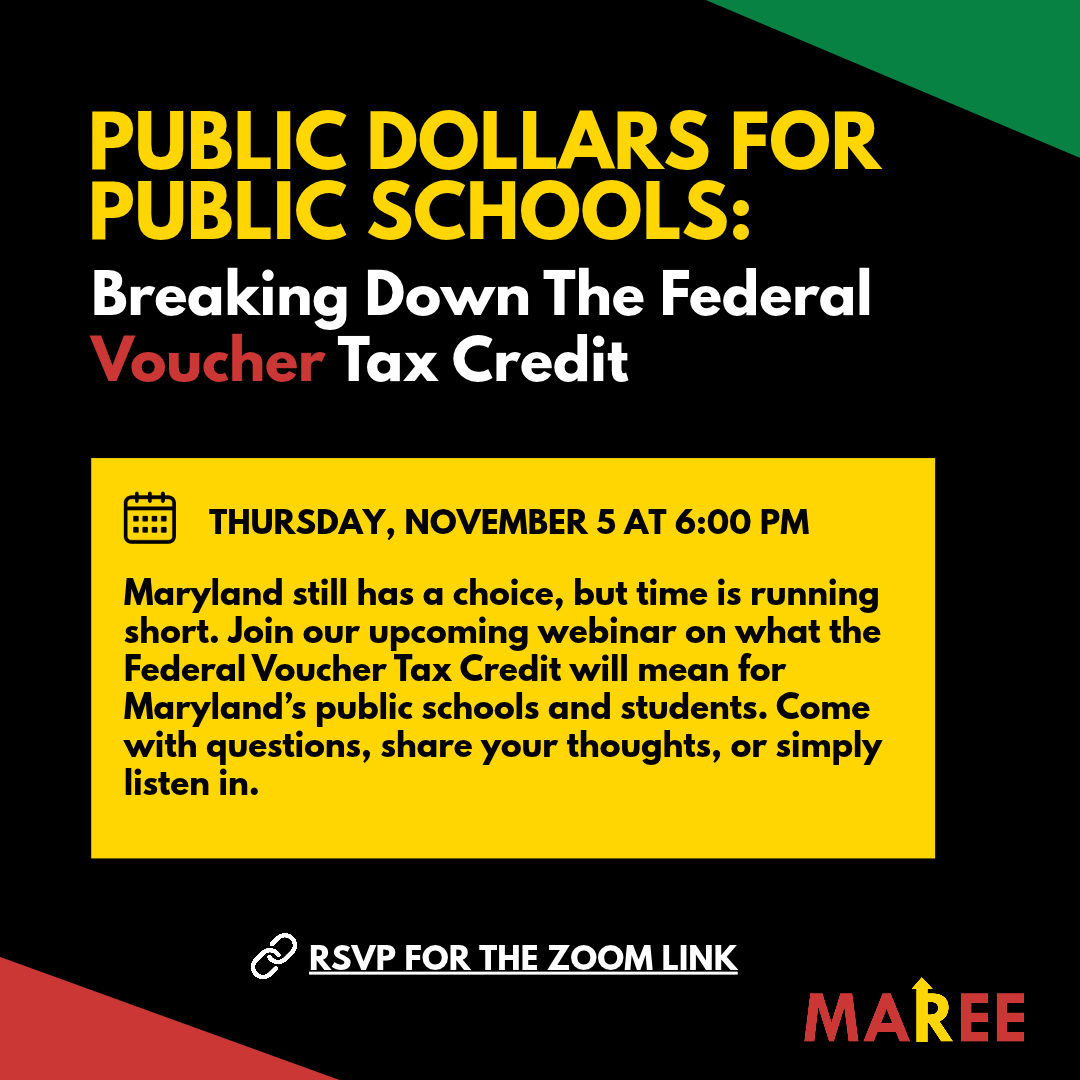 PUBLIC DOLLARS FOR PUBLIC SCHOOLS: BREAKING DOWN THE FEDERAL VOUCHER TAX CREDIT
PUBLIC DOLLARS FOR PUBLIC SCHOOLS: Down The Breaking Down The Federal Voucher Tax Credit THURSDAY,
 MAREE’s Statement on the Federal Voucher Tax Credit
The federal voucher tax credit, recently created by Congress and signed into law with the
Maryland Alliance for Racial Equity in Education (MAREE) Statement on the Departure of Superintendent of Schools Mohammed Choudhury
The Maryland Alliance for Racial Equity in Education (MAREE) extends our sincere appreciation and gratitude
MAREE Releases Statement on Reversal of Governor Hogan’s Education Cuts
Amidst relentless public pressure, the Governor released a supplemental budget restoring $125 million in funding
Maryland Alliance for Racial Equity in Education (MAREE) Calls on the AIB Nominations Committee to Prioritize Racial Equity
ANNAPOLIS, MARYLAND – With days left for application submissions to the Blueprint’s Accountability and Implementation Board
Written Testimony on Implementing Pell Grant Eligibility
As a national nonprofit organization working to close opportunity gaps that disproportionately affect students of
Maryland Alliance for Racial Equity in Education (MAREE) Releases Recommendations for Implementing Kirwan to Close Racial Equity Gaps
Over half of Maryland’s students are Black and Latino, and yet far fewer Black and
MAREE: Lack Of Representation In Blueprint’s Accountability And Implementation Board Alarming
(Via ACLU MD) ANNAPOLIS, MD – After the Accountability and Implementation Board (AIB) Nominating Committee